Cancellations for Thursday, February 17, 2023

St. Clair County

The St. Clair County Genealogy Workshop scheduled for tonight is going to be rescheduled til March 3rd at 6pm due to the weather. For more information about this event, go <HERE>.


Submit your weather-related closings to Jessie at jessie@wgrt.com

St. Clair County Man Wins $1 Million on Scratch Off Ticket

A 91-year-old man from St. Clair County got a nice surprise when he began scratching off the numbers on a Michigan Lottery Red Hot Millions Instant Game ticket.

“Red Hot Millions is one of my favorite games and I play it quite often. The $1 million prize was the first thing I scratched off, so I knew I’d won big right away. I was so happy! I have won smaller amounts in the past, but nothing compared to this,” said the player who wishes to remain anonymous.

The winner purchased the lottery ticket at the Mobile Gas Station on 32nd Street in Port Huron, and he wants to help his family with the winnings.

The $1 million payout from the Red Hot Millions game can be released in a lump sum of about $634,000 or as one payment a year for 30 years for the full $1 million. The St. Clair County winner chose to take the lump sum.

The Michigan Lottery reports that lottery players won more than $1.5 billion playing instant games in 2020, and in the 2021 fiscal year, the lottery provided more than $1.419 billion for public schools in Michigan.

Reporting for WGRT – Jessie Wiegand

MI Tri-Share Child Care Pilot Program Expands to St. Clair County

The MI Tri-Share Child Care Pilot Program has expanded to seven new counties, including St. Clair County. Fifty-two counties in Michigan are now covered by the program. St. Clair County is serviced by the St. Clair County RESA.

Dr. Kevin Miller, Superintendent of St. Clair County RESA explained, “The Tri-Share program is designed to address the current childcare crisis, making childcare more affordable for working families in St. Clair County. “

Miller said, “We’ve been collaborating with our Economic Development Alliance (EDA), Michigan Works, and our business partners. Our RESA will be the Tri-Share ‘hub’ as we have the connection with county childcare providers through our Great Start Collaborative. The power of the Tri-share grant is the cost-sharing between the State of Michigan, the business community, and our hard-working families.”

St. Clair County will have $300,000 available for the program for this year. Participation with area businesses will be coordinated by the EDA. Aludyne is one of the supporting businesses that helped secure the grant.

Details about the Tri-Share program, including current pilot regions and participating employers, can be found at michigan.gov/Tri-Share.   

Reporting for WGRT – Jennie McClelland

Beeler Answers Questions Regarding Curriculum Transparency Bill

State Representative Andrew Beeler has responded to questions about House Bill 5722 that he has co-sponsored.

The bill calls for the entire lesson plan for the entire year for every classroom to be made public prior to the start of the year and levies a 5% reduction in school aid for non-compliance. The bill is in committee and has not yet been voted on.

Beeler said, “I think it is necessary to have transparency in curriculum as parents have a right to know what is and what isn’t being taught to their children. 

It is necessary for parents to know what their children are being taught. The majority of parents in this state and across the country think its necessary as well. Schools should have no reason to want to conceal this information from parents. Additionally, better transparency is good for our teachers and schools. When parents aren’t able to see what their child’s curriculum consists of, they assume the worse or seek another, more transparent school. 

As lesson plans are prepared by teachers in advance of a school year so too are department curriculums. The additional burden placed on schools to provide this information seems pale in comparison to the added benefit that transparency provides. Teacher shortage or not, it is always the right time to do what is best for our students.” 

House Fiscal analysis reported that, if passed, the legislation would impose an indeterminate, but potentially significant, cost to school districts and the Michigan Department of Education, which would be required to monitor the reporting.

Reporting for WGRT – Jennie McClelland

Moore Public Library Seeks Input on Funding for Expansion

The Moore Public Library in Lexington decided to expand their space by purchasing an adjacent property in 2017. Due to setbacks caused by the pandemic, progress on the expansion slowed, but they are hopeful grant money can reinvigorate the project.

The Moore Public Library was built in 1859 and opened as a public library in 1903. At a public meeting in 2017, patrons agreed that an expansion that included the purchase and remodeling of the building next door would add amenities to the library and make it ADA compliant.

Over $340,000 has been raised toward the building project, but costs have dramatically increased and the pandemic took a toll on fundraising activities. Building campaign leaders are now exploring two new sources to get the project back on track.

The American Rescue Plan allows grant money to be used for Revitalization and Placemaking, and there is also an opportunity for the library to receive a loan from the USDA. If either opportunity for funding is successful, organizers hope to begin construction this year.

A public hearing is scheduled for February 23, 2022 at 7 PM for those who would like to learn more about these funding opportunities.

Reporting for WGRT – Jessie Wiegand

MDHHS Withdraws Mask Advisory for Indoor Public Settings

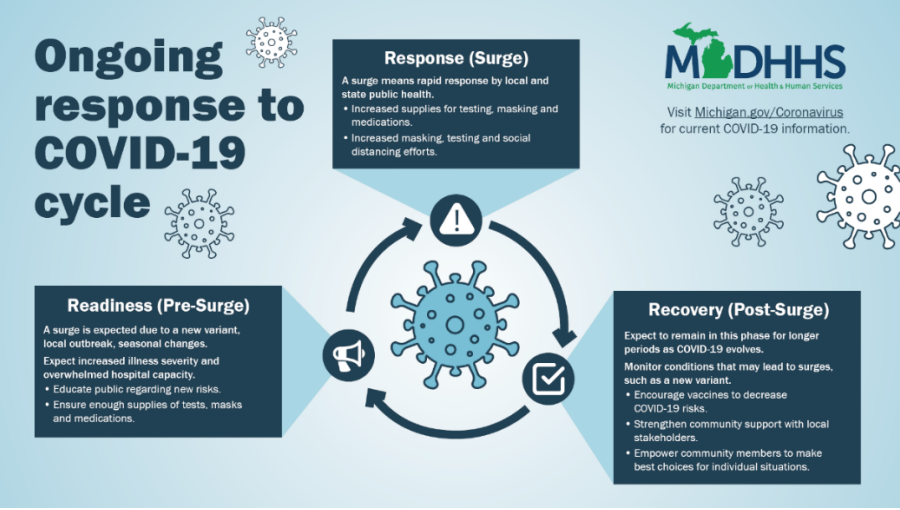
 As COVID-19 cases and hospitalizations continue to decline in the state, the Michigan Department of Health and Human Services (MDHHS) is updating its mask guidance for public settings, including school settings, to reflect that Michigan is entering a post-surge, recovery phase.

Moving forward, the COVID-19 cycle can be broken down into three key phases:

  • Response – Local and state public health implement rapid response to a surge.The public may be advised to increase masking, testing and social distancing.
  • Recovery – Post-surge. No immediate resurgence predicted. Local and state public health will monitor conditions that could lead to future surges.
  • Readiness – A surge in cases is expected, with implications on severity of illness and hospital capacity. Increased communication to the public regarding possible new risks.

Currently, decreases in cases and hospitalizations and increased access to vaccines, testing and treatment indicate that Michigan is entering a post-surge, recovery phase of the cycle. 

During this phase, MDHHS recommends that all individuals, regardless of vaccination status, continue to practice universal masking in high-risk congregate settings including long-term care facilities, homeless shelters, correctional facilities, jails and health care facilities. All individuals, regardless of vaccination status, should also wear a mask during isolation and quarantine periods to stop further community spread of COVID-19.  

School districts and organizations should consider local conditions and work with their local health department to determine mask policies for school districts, public meetings and large events. Masks are an important tool in mitigating spread of COVID-19 and individuals who may be at higher risk of infection or who feel better protected when masked should choose when they feel comfortable masking.

“This is good news for Michigan,” said Gov. Gretchen Whitmer. “While Michigan hasn’t had statewide mask policies since last June, this updated guidance will underscore that we are getting back to normal. Let’s keep working together to build on our momentum so we can keep our kids learning in person.”

“Individuals and families should assess their own risk for COVID-19 exposure and transmission and make choices about when it makes sense to wear masks,” said Elizabeth Hertel, MDHHS director. “We want to make sure individuals and local communities have the information and tools they need to make choices for their families based on their personal situation and local community conditions. We continue to strongly urge all residents ages 5 and older get the safe and effective COVID-19 vaccine and to get boosted when eligible as the vaccine continues to be our best defense against the virus.”

Today’s announcement follows Governor Whitmer’s signing of the bipartisan $1.2 billion supplemental funding bill, which includes $150.8 million for testing and screenings in schools so kids can continue safely learning in-person.

Michiganders should consider their individual and family members’ risk factors and vaccination status when making the personal decision whether to mask. Those with chronic illnesses or who are immunocompromised are at higher risk for poor outcomes from COVID-19 and would benefit most from masking in indoor settings. These risk factors may include age, medical conditions and vaccination status.

MDHHS will continue to monitor the transmission of COVID-19 closely to assess risk across the state and adjust as conditions change. These changes could include the presence of a new variant that increases the risk to the public, or an increased number of cases that strains the health care system. 

MDHHS continues to recommend the use of layered mitigation strategies for Michiganders:  

  • Get vaccinated against COVID-19.Michiganders should get up to date on their COVID-19 vaccine. Learn more about vaccines and when you’re up to date at gov/COVIDVaccine
  • After testing positive for COVID-19, individuals are encouraged to talk to their doctors about whether they meet eligibility criteria and should get antibody or antiviral treatment to help with their recovery.  
  • Isolation and Quarantine.Staying away from others when you are sick or were recently exposed to COVID-19 are important tools to preventing further spread of the virus. Learn more about what happens when you have or are exposed to COVID-19 
  • Get tested if you are exposed or have symptoms.Anyone with signs or symptoms of COVID-19 should get tested regardless of vaccination status or prior infection. If you get tested because you have symptoms or were potentially exposed to the virus, you should stay away from others while you wait for your test result. Testing before unmasked gatherings provides an additional layer of protection.  Find a test site at gov/CoronavirusTest.
  • Take additional steps to protect yourself and others. For additional guidance on mitigation strategies see How to Protect Yourself and Others.  
  • Get a free mask. Free KN95 masks are being distributed by community organizations, including local MDHHS offices, health departments and Area Agency on Aging offices. Residents who want masks can obtain masks from partner agencies across the state. Michiganders are asked to refer to partner websites or social media sites to find out about mask availability as opposed to calling sites.

Submitted by MDHHS